

I haven’t yet figured out to whom I should attribute this annonymous image from Facebook. But I like how it portrays the gritty realism of 16th-century Spaniards landing on some remote, possibly hostile, shore in the New World. Those were some hard-core people bent on conquest.
By now, it’s generally accepted that on April 10, 1528 or so, the Narváez force landed on the shore of today’s St. Petersburg, FL, near a pass into Boca Ciega Bay. They had slightly overshot their intended target of Tampa Bay. A native mound site now called Jungle Prada in Narváez Park near St. John’s Pass is as likely the landing spot as any, although no Spanish artifacts have been found there. A sign reads: Here landed Pánfilo de Narváez, April 15, 1528. From the site of this ancient Indian village was launched the first exploration by white man of the North American continent. There is also an engraved stone monument in Henry B. Plant Park inTampa, FL, erected in 1928 to commemorate the 400 anniversary of the landing.
From the Spanish point of view the expedition was a failure and a disaster. But the report of the four survivors eight years later inspired bigger expeditions to explore the southern U.S. by De Soto and Coronado. All three were the first major interactions between Europeans and native peoples in North America. The latter would be changed forever as many tribes were devastated by unfamiliar diseases like smallpox.
As we approach the Narváez quincentennial, a new monument to the expedition has been proposed to the city of St. Petersburg, FL. https://stpetecatalyst.com/will-st-pete-commemorate-its-most-significant-historical-event/ It would feature three statues: a chief of the Tocobaga tribe native to the landing site, and those of two survivors—the Moorish slave Estevanico and the expedition’s treasurer, Cabeza de Vaca, who wrote the famous account of it. To my knowledge, the only other such monument is a bronze bust of Cabeza de Vaca in Houston, TX. https://hermannpark.org/place/alvar-nunez-cabeza-de-vaca/
Strangely enough, there were large statues of Narváez and Andrew Jackson near the Washington Monument in the early 1900s. (See my blog post of 12/4/2025.) I haven’t yet found out if they still exist somewhere. Perhaps other monuments or plaques will follow as public recognition of this milestone anniversary grows.

In terms of accomplishing its avowed mission, the Narváez expedition was largely a failure. In contrast, the Hernando de Soto expedition to La Florida 11 years later was a much more successful exploration of that vast territory, even though it also failed to enrich the survivors. What accounts for the difference in outcomes? Was it leadership? Planning? Resources? Among other factors, those three best explain the difference. Both expeditions were launched near Tampa Bay and made the same inland trek to Apalache, where they controlled the hostile population more effectively. After a rendevous with their supply ships, De Soto’s party continued exploring for another 3,000 miles or so across the southeastern U.S., before some 300 survivors—about half of the expedition—built boats near the mouth of the Mississippi River and sailed westward along the coast to Mexico.
Both Narváez and De Soto were physically imposing men but not equally competent leaders. Narváez had led Spanish soldiers in the conquest of Cuba, where the native Taíno were generally a peaceful, agrarian people. They resisted the Spanish, but were no real match for them militarily. The real test of Narváez’s leadership came in 1520, when he was sent by the governor of Cuba to arrest Hernán Cortés and replace him as the legitimate conquerer of Mexico. But the wily Cortés, through a combination of guile, bribery, and audacity, and with a fourth as many men, turned the tables on Narváez and took control of his army, making Narváez his prisoner for two years or so.
In comparison, Hernando de Soto had gained more hard-core military experience in the New World. He came to Central America as a teenager and soon made his reputation as a fighter and leader, taking part in the conquest of Veragua (now Nicaragua, Costa Rica and Panama). He later joined forces with the Pizarro brothers in the conquest of the Inca Empire in Peru. That lucrative conquest and his later marriage into the powerful Bobadilla and Peñalosa families made him even wealthier. In 1537, the king appointed him adelantado (conqueror) of La Florida—given that Narváez had vanished—and governor of Cuba. Only months later, De Soto learned that four men had survived the Narváez expedition. Its treasurer Cabeza de Vaca described their grueling experience in the wilderness but also talked up the potential for rich discoveries in that vast and varied landscape.
The story inspired De Soto to mount his own expedition, which he launched by way of Cuba to its landing near Tampa Bay in May 1539. His force consisted of about 700 men, many of them loyal Peru veterans, kinsmen, and fellow Extremadurans from Spain. He landed with nine ships and an army better equipped, provisioned, and staffed with skilled personnel, compared with that of Narváez. De Soto was more prudent in establishing a base there for resupplying the expedition by sea. Also, he had the good luck to aquire an interpreter and guide, a Spaniard capured by Indians from the Narváez troops. Finally, it’s clear that De Soto was more adroit than Narváez in leading his army effectively and managing their interactions with native peoples thoughout the long march though unfamiliar cultures and terrains. The expedition’s success and survival was a testament to his strong leadership, even after his death toward the end.
Updated: Mar 10
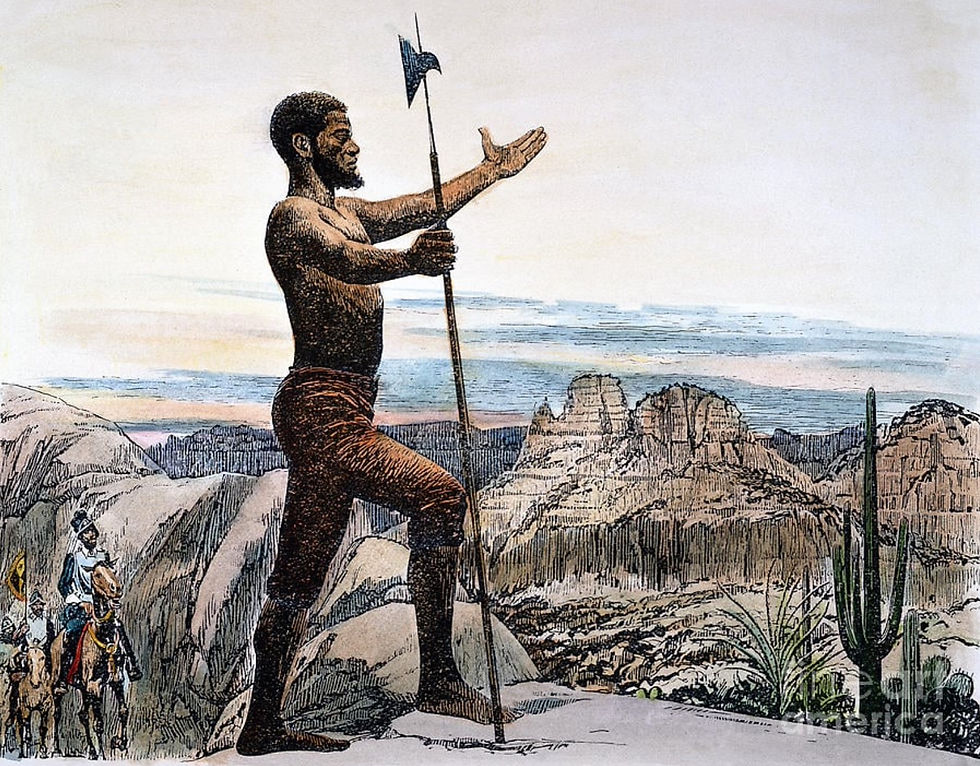
Only four of the 300 conquistadores who landed near Tampa Bay in 1528 survived to reach Mexico eight years later. One of them was a Moor, Estevanico (or Estebanico), described in Cabeza de Vaca’s account as the slave of Captain Andrés Dorantes (another survivor). Although Estevanico is mentioned 13 times in the account, it is never from his own point of view. Nonetheless, he appears to have played an important role in their survival, primarily as someone with a talent for communicating with native peoples by signs or in their languages. In one instance, the others send him forward alone to establish contact with a new tribe. Perhaps the natives were also intrigued by his North African appearance as distinct from most of the Spaniards and other Europeans in the expedition. Estevanico was originally from “Azamor” (Azemmour?), Morocco on the Atlantic Coast. Along with his other talents, he might also have had boating experience, though he apparently couldn’t swim. In other ways he was apparently a very resourceful and durable individual.
Once the four survivors had been rescued in Mexico, they prepared a joint report on their grueling experience. Despite his lower status, Estevanico must have provided valuable, if unacknowledged, input. At least his abilities were recognized by the Viceroy Mendoza of Mexico, who “purchased” him from Andrés Dorantes. Two years later, he became a guide on the expedition of Francisco Vázquez de Coronado to further explore the southwest in search of the mythical, golden Seven Cities of Cíbola. Acting as an advance scout, Estevanico was killed by natives of Cíbola under somewhat obscure circumstances.
Laila Lalami has written an award-winning novel, The Moor’s Account, which is an imagined memoir of Estevanico, portrayed as a remarkable storyteller.


